
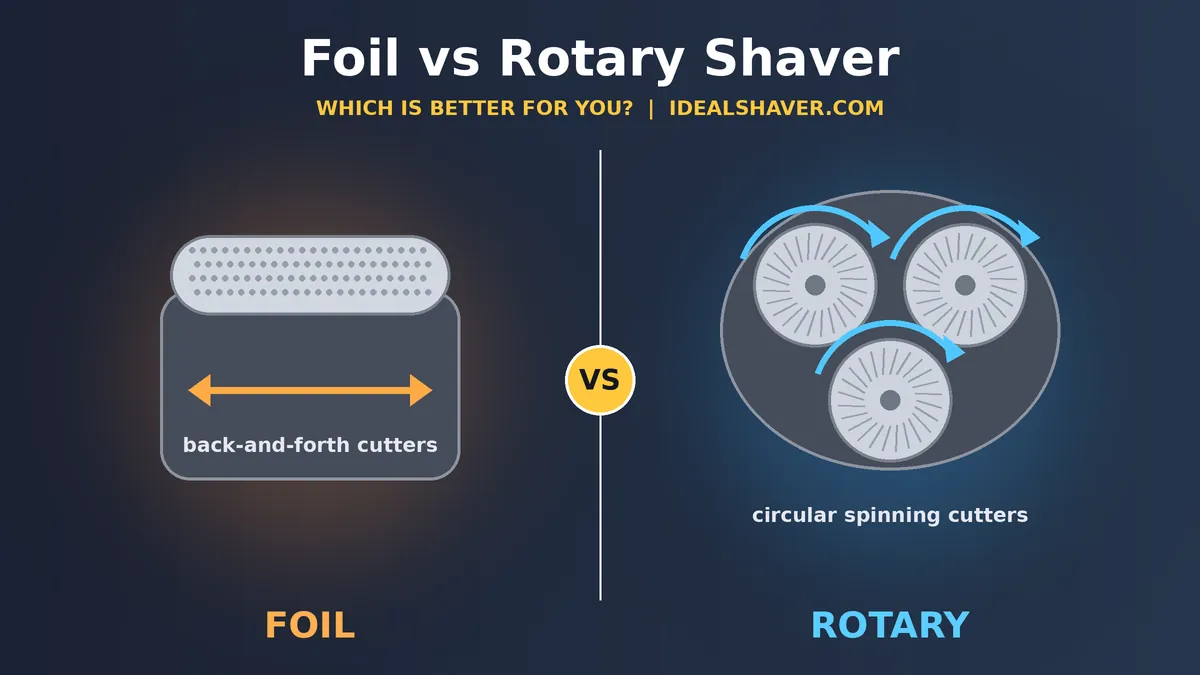
The foil vs rotary shaver question is the first decision every electric shaver buyer has to make, and it matters more than brand, price or extra features. Foil shavers cut with blades that move back and forth under a thin metal screen. Rotary shavers use round heads with blades that spin in circles. As a result, each design suits a different kind of beard, skin type and shaving habit.
Disclosure: IdealShaver is reader-supported. When you buy through links on this page, we may earn an Amazon affiliate commission at no extra cost to you.
In this guide we explain how each type works, compare closeness, comfort, speed, noise and upkeep, and help you decide which one fits your face. We also share our favourite foil and rotary shavers for 2026 at every budget.
Foil vs Rotary Shaver: The Short Answer
- Choose a foil shaver if you shave daily, have fairly straight hair growth, want the closest result on the cheeks and chin, and like quick, straight strokes.
- Choose a rotary shaver if your hair grows in different directions (especially on the neck), you shave every few days, you have a strong jawline or prominent Adam’s apple, or you prefer circular motions.
In short, neither type is better for everyone. The best shaver is the one that matches your beard and your routine.
How a Foil Shaver Works
A foil shaver has one or more thin, perforated metal foils curved over a set of blades. When you press the head against your face, hairs poke through the holes in the foil and the blades underneath slice them off as they oscillate side to side. Since the foil is extremely thin, the blades can cut very close to the skin while the foil protects you from direct contact.
In addition, premium foil shavers add extra elements. For example, the Braun Series 9 Pro+ combines two foils with middle cutters designed for flat-lying and multi-direction hairs, plus a pop-out trimmer. The Panasonic Arc5 uses five blades driven by a fast linear motor. For a closer look at the technique, read our guide on how to use a foil shaver.
How a Rotary Shaver Works
A rotary shaver usually has three (sometimes four) round heads. Each head contains circular blades spinning behind a guard with slots. Also, the heads float and flex independently, so they follow the curves of your jaw, chin and neck. Because the blades move in circles, they catch hairs growing in any direction.
For example, Philips Norelco is the best-known rotary brand. Its newer models add sensors that read beard density and adjust power, and flexible heads that tilt to keep contact in tricky areas. You can learn about all shaver designs in our guide to the different types of electric shavers.
Foil vs Rotary Shaver Comparison Table
| Factor | Foil shaver | Rotary shaver |
|---|---|---|
| Cutting motion | Back-and-forth blades under a foil | Circular spinning blades in round heads |
| Shaving motion | Straight up-and-down strokes | Small circular motions |
| Closeness on flat areas | Excellent | Very good |
| Neck and jawline | Good | Excellent |
| Longer stubble (3+ days) | Good on premium models | Very good |
| Hairs growing in many directions | Fair to good | Excellent |
| Edging sideburns | Easy, square head | Harder, round head |
| Noise | Usually louder | Usually quieter |
| Fragility | Foil can dent if dropped | Heads are sturdier |
| Typical brands | Braun, Panasonic, Remington | Philips Norelco, Remington |
Foil vs Rotary Shaver Closeness: Which Is Closer?
On flat areas like the cheeks and upper lip, a good foil shaver usually feels a little closer after fewer passes, because the foil sits flat and the blades cut right beneath it. That is why many daily shavers swear by foil models such as the Braun Series 9 and Panasonic Arc5.
On the other hand, rotary shavers shine on curved areas. On the neck, under the jaw and around the chin, the flexing round heads keep better contact and catch swirling hairs that a foil might miss. Still, modern premium rotary shavers can get very close too, so the gap is smaller than it used to be. If closeness is your top priority, see our list of the best close-shave electric razors.
Foil vs Rotary Shaver for Sensitive Skin
In general, both types can be gentle if you use the right technique. Foil shavers often need fewer passes, which means less friction. Meanwhile, rotary shavers spread pressure across three floating heads and move in small circles, which some people find softer on the neck.
The biggest cause of irritation with either type is pressing too hard or going over the same spot again and again. The American Academy of Dermatology also stresses technique, such as shaving when hair is soft and in the direction it grows, in its razor bump prevention tips. Our guides to the best electric shavers for sensitive skin and getting rid of razor bumps on the neck go deeper.
Finally, give any new shaver two to three weeks. Your skin usually needs time to adjust when you switch from blades or from one shaver type to the other.
Foil or Rotary Shaver for Thick Beards and Long Stubble?
If you only shave every few days, or your beard is dense and coarse, a rotary shaver is often more forgiving because its circular blades lift and catch longer hairs from every angle. In contrast, budget foil shavers can struggle with 3+ day stubble and may tug.
That said, high-end foil shavers now include dedicated cutters and pop-up trimmers for longer hairs, so a premium foil model handles stubble far better than an entry-level one. For coarse, curly hair that grows in many directions, rotary still has the edge.
Foil vs Rotary Shaver: Speed, Noise and Ease of Use
Foil shavers are fast once you learn the motion: straight strokes against the grain, with light pressure. Their square heads also make it easy to tidy sideburns and moustache lines. Even so, they do tend to be louder because of the oscillating motor.
However, rotary shavers take a few days to master if you are used to straight strokes, since you need small circles. On the plus side, they are usually quieter. Whichever you choose, our guide on the best way to shave with an electric razor will help you get better results faster.
Wet or Dry Use in a Foil or Rotary Shaver
Most modern foil and rotary shavers are waterproof and work wet with gel or foam, or dry. Wet shaving can feel smoother on sensitive skin, while dry shaving is quicker and needs no prep. Wondering about foam? Read can you use shaving cream with an electric razor.
Foil vs Rotary Shaver Maintenance and Replacement Costs
- Foil shavers: the foil is the most delicate part and can dent or tear if dropped. Braun, for example, recommends replacing the Series 9 Pro+ foil and cutter cassette about every 18 months.
- Rotary shavers: the heads are sturdier and many have self-sharpening blades. Philips, for example, rates the i9000 blades for about two years.
In any case, clean either type regularly by rinsing under the tap or using a cleaning station. See how long electric razors last for tips on extending their life.
Pros and Cons of a Foil Shaver (vs Rotary)
Pros
- Very close shave on flat areas
- Fast, straight strokes for daily shavers
- Easy edging around sideburns and moustache
- Great choice for head shaving too (see our best electric shavers for head)
Cons
- Delicate foil can be damaged
- Budget models can tug on longer stubble
- Usually louder
Pros and Cons of a Rotary Shaver (vs Foil)
Pros
- Excellent on neck, chin and jawline
- Catches hairs growing in any direction
- Handles longer stubble well
- Usually quieter, sturdier heads
Cons
- Learning curve for circular motion
- Round heads make sideburn edging harder
- May need more passes on flat cheeks
Best Foil Shavers in 2026
1. Braun Series 9 Pro+ 9667cc: Best Premium Foil Shaver
Braun’s flagship uses a 5+1 foil system with two foils, specialised middle cutters and a built-in ProTrimmer. Its Pro SensoAdapt sensor reads beard density 300 times per second and adjusts power. It is fully waterproof, made in Germany, offers up to 60 minutes of runtime, and comes with a 6-in-1 SmartCare clean-and-charge center. Read our Braun Series 9 review for more on this line.
Check Braun Series 9 Pro+ Price on Amazon
2. Panasonic Arc5: Best Mid-Range Foil Shaver
The Arc5 pairs five sharp nanotech blades with a flexible pivoting head and a fast linear motor rated at 14,000 cuts per minute. A built-in sensor adjusts power to beard density, it works wet or dry, and it has a pop-up trimmer for sideburns. It charges in about an hour. See our Panasonic Arc 5 review and Panasonic Arc5 vs Braun Series 9 comparison.
Check Panasonic Arc5 Price on Amazon
3. Braun Series 3 ProSkin: Best Budget Foil Shaver
A simple, reliable entry-level foil shaver with a 3-element floating system, a precision trimmer and a MicroComb to catch more hair. It is wet and dry, gives about 45 minutes of shaving per charge, and a 5-minute quick charge is enough for one shave. More options are in our best budget electric shavers guide.
Check Braun Series 3 Price on Amazon
Best Rotary Shavers in 2026
1. Philips Norelco i9000 Prestige: Best Premium Rotary Shaver
Philips’ top rotary line uses Triple Action Lift & Cut blades with 150,000 cutting actions per minute, compact Precision Flex heads, and AI-powered SenseIQ that adjusts power 500 times per second. A pressure guidance light, Bluetooth app support, a Quick Clean Pod and a 2-year self-sharpening blade lifetime round it out.
Check Philips Norelco i9000 Prestige Price on Amazon
2. Philips Norelco i9000: Best Value Flagship Rotary
The standard i9000 shares the Lift & Cut system, Precision Flex heads and SenseIQ power adaptation with the Prestige, but skips the cleaning pod and app features to save money. It includes a nose trimmer, charging stand and travel case, and is 100% waterproof.
Check Philips Norelco i9000 Price on Amazon
3. Philips Norelco 7800: Best Mid-Range Rotary Shaver
The 7800 offers 45 self-sharpening SteelPrecision blades with up to 90,000 cutting actions per minute, 360-degree flexing heads and an adaptive sensor that reads beard density 250 times per second. It works wet or dry, charges fully in an hour (5 minutes gives one shave) and has a pop-up trimmer. Note that a wall adapter is not included.
Check Philips Norelco 7800 Price on Amazon
Who Should Buy a Foil or a Rotary Shaver?
A foil shaver is better for you if:
- You shave every day or every other day
- Your beard grows mostly in one direction
- You want sharp edges around sideburns and moustache
- You also shave your head
A rotary shaver is better for you if:
- You shave every two to four days
- You have swirls or multi-direction growth on the neck
- You have a pronounced jawline or Adam’s apple
- You prefer a quieter shaver
Shopping for someone specific? See our picks for older men, teenagers and wet and dry shaving.
Foil vs Rotary Shaver FAQs
Is a foil or rotary shaver better for the neck?
Rotary shavers are usually better for the neck because their flexing round heads follow the curves and catch hairs growing in different directions.
Which is closer, foil or rotary?
Foil shavers tend to be slightly closer on flat areas like the cheeks, while rotary shavers do better on curved areas. Premium models of both types get very close.
Which type is better for sensitive skin?
It depends on your face. Many people with sensitive skin prefer foil because it needs fewer passes, while others prefer rotary for its gentle circular motion. Light pressure and good technique matter most.
Can I switch from foil to rotary?
Yes. Expect a two to three week adjustment period while your skin and technique adapt to the new motion.
Is a foil shaver or a trimmer better for stubble?
For a clean shave use a shaver; for keeping stubble at a set length, use a trimmer. Our shaver vs trimmer guide explains the difference.
Final Verdict: Foil vs Rotary Shaver
In the foil vs rotary shaver debate, there is no single winner. Pick a foil shaver like the Braun Series 9 Pro+ or Panasonic Arc5 if you shave daily and want maximum closeness with straight strokes. Pick a rotary shaver like the Philips Norelco i9000 Prestige or Norelco 7800 if you have neck swirls, a curvy jawline or longer stubble. Match the shaver to your beard, give your skin a few weeks to adjust, and you will get a comfortable close shave every time.